Wall modelling theory
General considerations
Generally, WMLES implies modelling of the dynamics of the inner layer of turbulent boundary layers instead of resolving them with the grid. This entails significant computational savings at high Reynolds numbers, compared to performing a wall-resolved LES. A word of warning: WMLES is not cheap. Quite the opposite, WMLES is still expensive and is, for that reason, only starting to be used in applications, primarily in aerodynamics.
Note that the definition is rather general in the sense that it doesn’t define how the inner layer is to be modelled. On the other hand, it is quite specific since it applies only to attached boundary layers with a clear separation between outer and inner scales. This library only provides functionality for so-called wall stress modelling. This is a particular type of WMLES, in which the lack of inner layer resolution is compensated by providing the correct value of the wall shear stress. Providing this value is the task of the wall model. Wall stress modelling fits naturally into the numerical framework of OpenFOAM, i.e. finite volume discretization.
A schematic of how a wall-stress model works is shown in Fig. 1. For each wall face we consider some point away from the wall, located at a distance \(h\). At this point, we can sample the solution to the LES equations, for example, the velocity and pressure gradient vectors. These sampled values are given to the wall model, which uses them to predict the wall shear stress \(\bar \tau_w\).
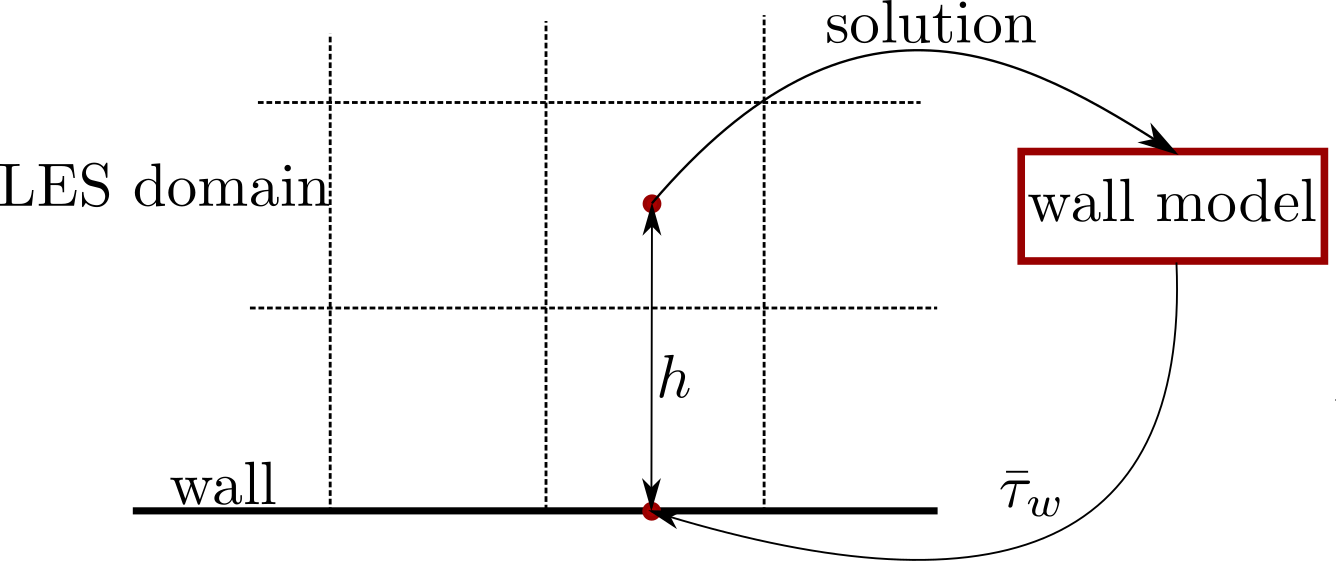
Fig. 1 Modus operandi of a wall-stress model.
This library provides associated functionality:
Possibility to define an arbitrary \(h\) for each face.
Sampling relevant fields and temporal averaging of the sampled values.
A set of wall models implemented as boundary conditions for
nut.
Documentation on particular models is provided in the header .H files of
corresponding classes. Below, a summary of the models is given and links to
appropriate classes are provided.
Algebraic models
These are essentially wall functions: some law of the wall is used to connect
the sampled LES solution to the wall shear stress. Implemented in the library as
the Foam::LOTWWallModelFvPatchScalarField class, see its documentation
for further details. A multitude of laws of the wall are implemented:
Spalding’s law,
Foam::SpaldingLawOfTheWallReichardt’s law,
Foam::ReichardtLawOfTheWall.Werner & Wengle’s law,
Foam::WernerWengleLawOfTheWall.Integrated Reichardt’s law,
Foam::IntegratedReichardtLawOfTheWall.Integrated Werner & Wengle’s law,
Foam::IntegratedWernerWengleLawOfTheWall.Log law for rough walls,
Foam::RoughLogLawOfTheWall.
The integrated versions are preferable if you use the wall-adjacent cell for
sampling. Otherwise, there is no large difference in what law to use, and
Spalding’s law is a reasonable default choice. The Newton root finder should be
used to solve the associated non-linear algebraic equation when a reliable
derivative is available. TOMS748 and Bisection are bracketed derivative-free
alternatives. Root finder dictionaries select the algorithm and may set
maxIter; all current algebraic root finders use the same fixed internal
binary digit target for the root estimate, and the tolerance is not
user-configurable.
ODE-based models
These models are based on an ODE formulation, yet the ODE is integrated, and the
model therefore only performs numerical integration using the trapezoidal rule,
and does not solve an ODE directly. The models differ in the treatment of the
right-hand side of the underlying ODE. For more details see the
Foam::ODEWallModelFvPatchScalarField class.
The following models are available
Equilibrium ODE model,
Foam::EquilibriumODEWallModelFvPatchScalarField. Right-hand side of the ODE is set to 0.Pressure gradient ODE model,
Foam::PGradODEWallModelFvPatchScalarField. The right-hand side is set equal to the pressure gradient.
Explicit model variants
Some wall models provide explicit variants that compute the wall shear
directly without entering a nonlinear root-finder or iterative inner solve.
Explicit variants are generally more robust and predictable, making them a
good choice for production runs or as a fallback when initial conditions are
poor.For the implementation and setup configuration see the
Foam::ExplicitWallModelFvPatchScalarField class.
The following explicit law classes are available in the code:
Spalding’s law
Foam::SpaldingExplicitLawOfTheWallReichardt’s law
Foam::ReichardtExplicitLawOfTheWallCai & Sagaut’s law
Foam::CaiSagautExplicitLawOfTheWallEquilibrium ODE model
Foam::EquilibriumODEExplicitLawOfTheWall